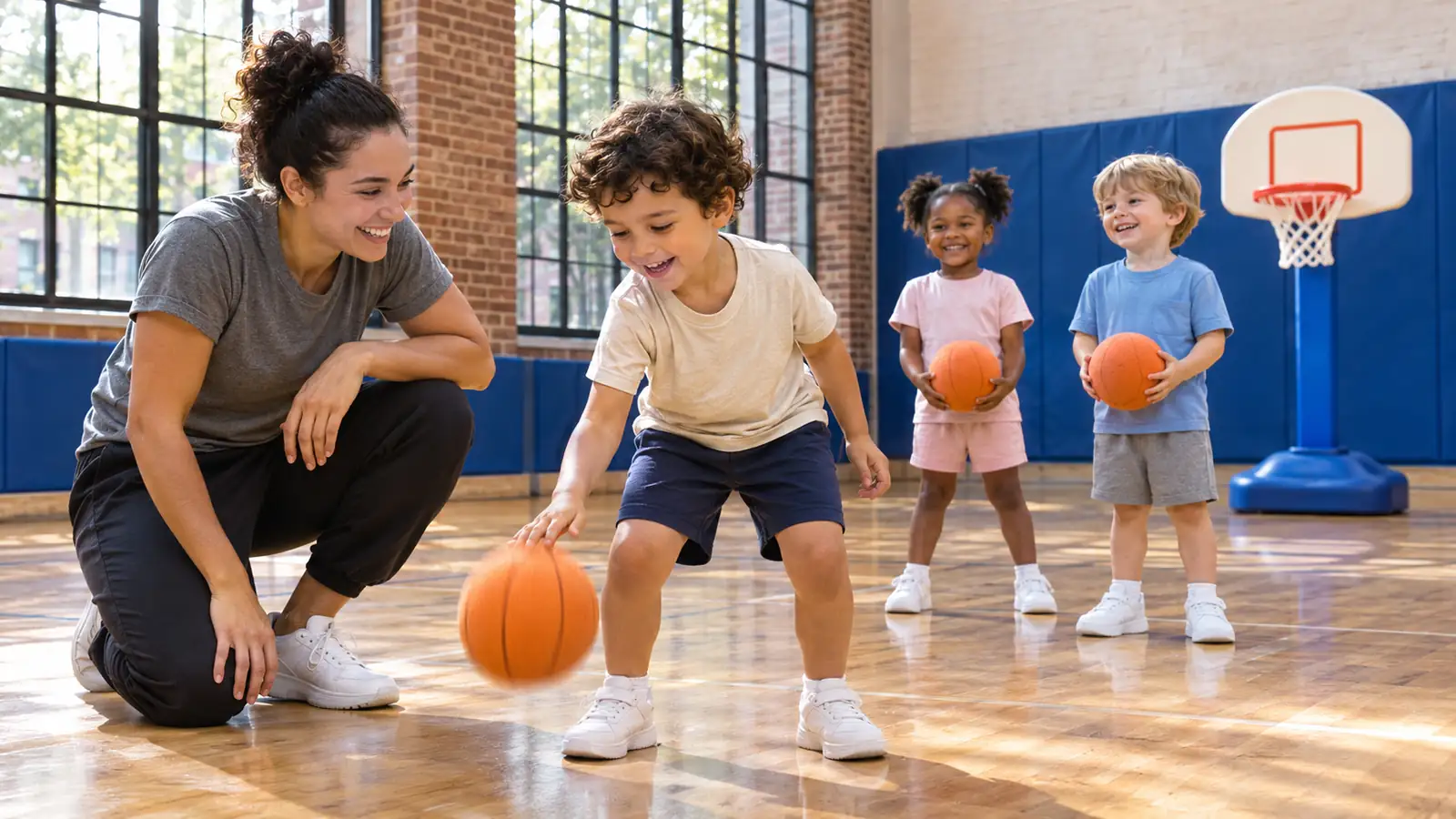
Basketball for 4 year olds should introduce movement, simple ball skills, and playing alongside other children through enjoyable activities. A first class can offer chances to roll, stop, bounce, pass, and aim a ball while following short instructions. Look for an introductory group that welcomes children who are still learning these skills.
Perhaps your child shoots into a toy hoop at home but freezes when another adult gives instructions. Or they love running around the gym and barely touch the basketball. What should you expect from that first session?
Look for a coach who can turn curiosity into an achievable activity. Learning might mean stopping a rolling ball, copying a movement, or joining a game after watching. These are useful things to notice when evaluating basketball for 4 year olds.
Table of Contents
- Is Your Child Ready for a Basketball Class?
- 7 Essential First Class Skills
- What a Playful First Class Could Look Like
- Small Balls, Low Targets, and Room to Move
- Five Beginner Basketball Games to Try
- If Your Child Watches, Wanders, or Won’t Join In
- Questions to Ask Before You Book
- What to Bring and Say Before the First Class
- Signs of Progress Beyond Scoring a Basket
- Keep Home Practice Short and Optional
- Finding Preschool Basketball in Brooklyn
- Questions Parents Ask
Is Your Child Ready for a Basketball Class?
Start with the format. Basketball for 4 year olds should be playful exploration with a ball and simple movement activities.
The American Academy of Pediatrics explains in its sports readiness guidance that most children younger than six are not ready for organized sports. For ages two to five, it favors active play, brief demonstrations, exploration, and avoiding competition.
Use that guidance when assessing a class. Ask how much time children spend playing, how instructions are demonstrated, and whether activities change when a child needs something simpler.
Consider your child’s interest and comfort in a group, too. Enjoying basketball at home doesn’t automatically mean enjoying a busy gym.
A parent described a child who could already dribble but worried that camp might reduce his enjoyment. That is one family’s experience, not evidence about all children. It raises a useful question: does the setting suit the child, beyond their ball skills?
If you’re comparing basketball for 4 year olds with options for older siblings, see our guide to when kids can start basketball classes.
Basketball for 4 Year Olds: 7 Essential First Class Skills
A first session of basketball for 4 year olds can introduce the following skills. Treat them as opportunities to explore, without expecting your child to complete every activity on day one. A coach can introduce fewer activities and return to the others later.
1. Moving and Stopping in Their Own Space
Begin with walking to a floor marker, changing direction, and stopping on a simple cue. A child can explore these movements before adding a ball.
Watch whether the coach leaves enough space between children and demonstrates the stopping signal. Repeating a familiar movement can be more useful than continually adding instructions.
2. Holding, Rolling, and Stopping a Ball
The first task might be rolling a soft ball to an adult and stopping the return with both hands.
If the ball repeatedly gets away, the coach can move closer or slow the roll. Basketball for 4 year olds should offer an easier version of an activity when needed, giving the child another way to take part.
3. Trying One Bounce and a Catch
A coach can demonstrate letting the ball bounce once, then gathering it with both hands. Children who want another challenge can try pushing it down and collecting it again.
Continuous dribbling is a separate challenge. There is no need to demand repeated bounces while walking during a first lesson. Ask whether the coach accepts a bounce-and-catch version while the child experiments.
4. Sending the Ball to a Partner
A gentle roll toward a nearby adult introduces aiming and noticing another person. A short bounce pass can be offered when the child is comfortable trying it.
The instruction should be concrete: “Send the ball toward my hands.” Distance and speed can change to make the task manageable. Sending the ball is more useful here than memorizing passing terminology.
5. Aiming at a Reachable Target
A low, securely installed hoop gives children a target they can attempt from nearby. A wide floor target is another option when shooting isn’t working.
Avoid judging the lesson by how many baskets go in. In basketball for 4 year olds, trying a comfortable two-handed toss can be enough of a challenge without adding detailed shooting corrections.
6. Following One Clear Instruction
“Stand on the blue spot” gives a child one action to try. A demonstration can accompany the words.
Compare that with asking a beginner to dribble around cones, switch hands, pass, and move to another line. Before deciding that a child isn’t listening, check how many things the adult asked them to remember.
7. Sharing Space and Taking a Brief Turn
Simple cooperation might mean returning a partner’s ball, waiting while someone finishes a turn, or helping collect equipment.
Keep the wait manageable by providing enough activities and equipment. Our guide to teamwork and sportsmanship in youth sports explores the broader topic. For a preschool beginner, start with these small interactions.
What a Playful First Class Could Look Like
The following is an illustrative activity sequence for basketball for 4 year olds. It is not a required curriculum, a timing standard, or New York Hoops Academy’s published lesson plan.
| Part of the session | Example activity | What a parent can notice |
|---|---|---|
| Arrival | Explore a ball beside a parent or coach | Is there time to settle in? |
| Movement | Walk between colored spots and freeze | Are directions easy to copy? |
| Ball exploration | Roll, stop, or try one bounce | Can the task become easier? |
| Partner play | Send a ball to a nearby adult | Does each child get turns? |
| Target game | Try a low hoop or wide floor target | Can children participate without scoring? |
| Finish | Repeat a favorite activity and help tidy | Can the child finish comfortably? |
A coach can shorten, repeat, or skip an activity as needed. Ask how a booked session includes breaks and settling time, rather than assuming the whole appointment consists of instruction.
For context on how instruction changes over time, explore our basketball curriculum overview. Older children’s activities should not become expectations for preschool beginners.
Small Balls, Low Targets, and Room to Move
Before buying equipment for basketball for 4 year olds, ask what the program supplies.
Look for a ball the child can hold comfortably and move without struggling with its weight. For an introductory rolling or catching activity, a soft ball may be more inviting. Ask the coach to show the equipment and explain the choice.
Be careful with online size charts. The NBA and USA Basketball youth guidelines begin their participation tables and detailed playing standards at ages seven to eight. Those figures should not be presented as official requirements for four-year-olds.
For a target activity, check that the hoop is stable and used according to its manufacturer’s instructions. Adults should handle adjustments. Children should have clear space to approach and retrieve a ball without crowding another activity.
Equipment is only part of the decision. Good coaching in basketball for 4 year olds includes noticing when the setup needs to change. Our guide to what makes a great youth basketball coach offers more questions to consider.
Five Beginner Basketball Games to Try
These are adaptable play suggestions for basketball for 4 year olds, not a prescribed training program. Use adult supervision, a clear space, and equipment appropriate to the child. Stop or simplify an activity when it stops being enjoyable.
Roll Through the Gate
Place two low markers far enough apart to make a generous opening. Sit opposite your child and gently roll a soft ball through it.
Invite them to stop the ball and return it. Move closer or widen the gate if necessary. The challenge is sending the ball toward a target, with no race or score needed.
Bounce and Collect
Show your child one bounce followed by gathering the ball. Offer a turn, then take a turn yourself.
If catching the rebound is frustrating, let the ball stop before collecting it. A child who enjoys the game can choose to try another bounce. Avoid setting a required streak.
Move and Freeze
Start without a ball. Walk in a clear area and stop together when someone says “freeze.”
Once the idea is familiar, the child can carry a soft ball while walking. This is a movement game; carrying is allowed. Don’t add dribbling until the child wants that extra challenge.
Find a Color
Set out a few flat, nonslip colored markers. Ask your child to walk to one color while holding the ball, then place it beside the marker.
Use one instruction at a time. They can choose the next color for you, giving them a turn to lead.
Choose Your Target
Offer a nearby low hoop or a wide floor target. Let the child choose where to aim and whether to roll or toss, depending on the target.
Move the target closer when necessary. These beginner basketball games should give children a way to participate even before they can shoot into a hoop.
If Your Child Watches, Wanders, or Won’t Join In
Treat the behavior as something to understand before deciding whether the class fits. Basketball for 4 year olds can involve an unfamiliar room, unfamiliar adults, and several things happening at once.
Ask what made participation difficult. Was the instruction confusing? Was the gym loud? Did the child want a parent nearby? Were they tired before arriving?
A practical response might be to watch one demonstration together, try a single roll with the coach, or take a quiet break where permitted. Discuss the approach with the instructor instead of giving competing directions from the sidelines.
If distress continues, pause participation and speak with the coach. You do not need to force a child through a session to prove readiness.
For basketball for 4 year olds, the coach’s response to hesitation is useful information. Look for patience, a simpler invitation, and willingness to talk with you. Our guide to supporting your child’s basketball journey without pressure offers more ways to approach those conversations.
Questions to Ask Before You Book
Before booking basketball for 4 year olds, ask about the specific group your child would attend. An academy’s overall age range does not establish that every class accepts preschoolers.
| Ask the program | Why the answer matters |
|---|---|
| Does this exact session accept children aged four? | Confirms eligibility for that group |
| What do children do if they cannot dribble? | Reveals whether simpler activities are available |
| How many children and supervising adults attend? | Helps you understand attention and supervision |
| May a parent watch or help a child settle? | Clarifies the separation and participation policy |
| What equipment is provided? | Avoids unnecessary purchases |
| How are breaks, bathroom needs, and accommodations handled? | Helps you plan for your child’s needs |
| What are the full fee, cancellation, and make-up terms? | Clarifies the commitment before payment |
When comparing basketball for 4 year olds, ask for concrete examples rather than accepting “beginner friendly” as the whole answer. You can also review our guide to choosing a youth basketball program in Brooklyn and meet the academy’s coaches.
What to Bring and Say Before the First Class
For a first session of basketball for 4 year olds, keep preparation straightforward:
- Comfortable clothing that allows easy movement.
- Clean indoor athletic shoes that meet the venue’s rules.
- A labeled water bottle.
- Any information staff need about your child’s support or health needs.
- Enough arrival time to find the entrance and bathroom without rushing.
Check whether a ball or uniform is provided before purchasing one. New York Hoops Academy’s Downtown Brooklyn and Fort Greene Pre-K page lists indoor shoes, comfortable clothing, and water, and states that basketball equipment is supplied.
Explain the visit simply: “We’ll meet the coach and try some ball games. You can ask for help.”
Avoid promising that the child will score, perform for you, or master a skill that day. Give them a clear idea of the activity without turning it into a test.
Signs of Progress Beyond Scoring a Basket
After basketball for 4 year olds, notice what became more familiar or manageable for your child.
They might have approached the coach, tried a new activity, aimed a roll toward a partner, or asked for another turn. These are observations you can discuss, not a checklist of achievements due after a fixed number of lessons.
Ask a specific question: “Which game would you play again?” You can tell the coach which activity your child mentioned at home and ask what adjustment helped them participate.
Our article on basketball and children’s confidence discusses encouragement more broadly. Keep your feedback grounded in what happened: “You tried that roll again” is clearer than predicting what kind of player your child will become.
Keep Home Practice Short and Optional
Home play can support basketball for 4 year olds without becoming homework. Invite your child to choose a favorite game, join them, and finish when their interest fades.
You do not need a hoop to roll a ball back and forth. Choose an appropriate clear area and avoid introducing bouncing where furniture, neighbors, or the floor make it unsuitable.
If your child wants playground time, dancing, or another activity instead, leave room for that choice. The AAP’s guidance on keeping sports enjoyable encourages varied activity and emphasizes free play for younger children.
Skip daily drill targets and comparisons with online videos. A preschooler’s interest does not need to become a specialization plan. Choosing to stop today’s game does not require a conversation about commitment or quitting.
Finding Preschool Basketball in Brooklyn
For families considering basketball for 4 year olds, New York Hoops Academy has dedicated Pre & K pages to check before selecting a general youth program.
The Downtown Brooklyn and Fort Greene program describes small hoops, soft basketballs, and playful introductory activities. Its location information appears under our Downtown Brooklyn and Fort Greene programs.
The separate Greenpoint Pre & K program lists ages four to five and a Greenpoint venue. Confirm the current address when choosing your session.
Start with our basketball locations, then confirm the exact group, address, schedule, price, and availability with the academy. Preschool sessions are different from the grade-based Development League shown on our youth basketball classes page.
Contact New York Hoops Academy about a suitable first class. Tell us your child’s age, preferred area, and whether they have tried a group activity before.
Questions Parents Ask About Basketball for 4 Year Olds
Does My Child Need to Dribble Before Joining?
A preschool introductory class should explain how it accommodates children who cannot dribble. Ask whether rolling, stopping, and bounce-and-catch activities are available. Do not assume “beginner” means the same thing across different programs.
How Long Should a Class Last?
There is no universal session length established by the sources reviewed here for basketball for 4 year olds. Ask what the booked time includes, how activities change, and whether children can take breaks. The schedule for older players is not a preschool standard.
Does My Child Need Special Basketball Shoes?
Check the venue’s requirements before buying a specialized pair. The academy’s Pre-K page specifies indoor shoes. Ask the program whether your child’s existing clean athletic shoes meet its requirements.
Is a Smaller Ball Always Better?
Size alone does not settle the choice. Weight, feel, and the activity also matter. Ask to see the ball used in class and whether staff offer an alternative if your child struggles to handle it.
What If My Child Only Wants to Play at Home?
That is a valid starting point. Basketball for 4 year olds can be an enjoyable family activity without enrollment. Keep offering opportunities to play, and revisit a class if your child becomes interested in that setting.