Basketball for 5 year olds doesn’t need complicated drills, competitive games, or strict training schedules. At this age, learning basketball can be as simple as bouncing a ball, passing to a parent, chasing a rolling basketball, or celebrating the first successful shot.
If your five-year-old struggles to dribble, catches the ball with both hands, or loses interest after a few attempts, that’s not unusual. Young children are still developing the coordination, balance, and attention needed for basketball.
The goal isn’t to create a skilled basketball player overnight. It’s to help your child feel comfortable with a basketball, enjoy moving, and discover that learning something new can be fun.
Parents can introduce basketball through simple activities at home, in a park, or during beginner classes. No previous basketball experience is necessary.
This guide explains seven practical basketball skills for young beginners, how to teach them through games, and how to recognize progress without putting unnecessary pressure on your child.
Table of Contents
-
Is Five Too Young to Start Basketball?
-
What Should a 5-Year-Old Learn First?
-
Seven Simple Basketball Skills and Drills
-
How to Teach Beginner Dribbling
-
A Simple Basketball Practice Routine
-
Choosing the Right Basketball Equipment
-
Common Mistakes Parents Should Avoid
-
How Basketball Can Build Confidence
-
When to Consider Basketball Classes
-
Helping Your Child Practice at Home
-
Questions Parents Frequently Ask
-
Making Basketball a Positive First Experience
Is Five Too Young to Start Basketball?
No. Five can be a suitable age to introduce basketball through play, simple movement activities, and beginner-friendly instruction.
However, there’s a difference between introducing basketball and expecting a child to play a structured game.
A typical basketball game involves several skills happening simultaneously. Players need to dribble, pass, understand boundaries, recognize teammates, and make quick decisions.
For a beginner who’s five years old, even bouncing the ball repeatedly can require considerable concentration.
That’s why basketball for 5 year olds should focus on basic movement, coordination, exploration, and enjoyment rather than competitive performance.
What Can a Typical Five-Year-Old Learn?
Children develop at different rates, but beginner basketball activities can introduce:
-
Holding and carrying a basketball comfortably.
-
Rolling and bouncing the ball toward a target.
-
Catching a gentle pass with both hands.
-
Attempting a stationary dribble.
-
Throwing a basketball toward a lowered hoop.
-
Moving, stopping, turning, and changing direction.
-
Following simple instructions and taking turns.
Some children might quickly learn to dribble several times in a row. Others may spend weeks learning how to push the ball toward the floor.
Both experiences can be part of normal beginner learning.
Why Fun Matters More Than Competition
When a child enjoys an activity, they’re more likely to ask to try it again.
A five-year-old who spends a few minutes happily passing a basketball with a parent may gain more from that experience than from a longer session filled with frustrating instructions.
USA Basketball’s foundational skills guidance emphasizes developing fundamental abilities such as ball handling, passing, shooting, footwork, and body control before placing heavy emphasis on full basketball competition.
Those principles are useful when introducing the game to young children, although the published framework is not a specific developmental checklist for five-year-olds.
If you’re considering structured instruction, explore the academy’s Pre-K basketball program, which introduces younger children to basketball through playful activities.
What Should a 5-Year-Old Learn First?
Before teaching a child how to shoot or dribble, help them become familiar with the basketball itself.
A child who feels comfortable holding, rolling, catching, and bouncing a ball has an easier starting point for learning more involved basketball movements.
Start With Ball Familiarity
Give your child a small basketball and allow them to explore it.
They might roll it across the floor, hold it above their head, move it around their waist, or bounce it using both hands.
These may not look like traditional basketball drills, but they introduce the relationship between hand movements and ball movement.
Try a simple game called “Follow the Ball.”
Roll the basketball slowly toward your child and ask them to stop it with both hands. Next, let your child roll it back.
As their control improves, change the direction slightly.
The activity introduces tracking, reaching, and responding to a moving object without requiring advanced coordination.
Teach Movement Before Complex Basketball Rules
Young beginners also benefit from practicing how to move safely around a playing area.
Try simple instructions:
“Run to the cone.”
“Stop when I clap.”
“Turn around.”
“Walk backward slowly.”
These activities introduce stopping, starting, directional movement, and body awareness.
Later, those same movement skills can support basic defense, dribbling, and footwork.
Parents interested in the game’s basic structure can also explore our beginner’s guide to youth basketball rules.
For now, however, your five-year-old doesn’t need to memorize the rules.
7 Simple Basketball Skills for 5 Year Olds
The following kids basketball drills are designed to introduce movement and ball control through games rather than repetitive technical instruction.
Each activity can be simplified depending on your child’s comfort level.
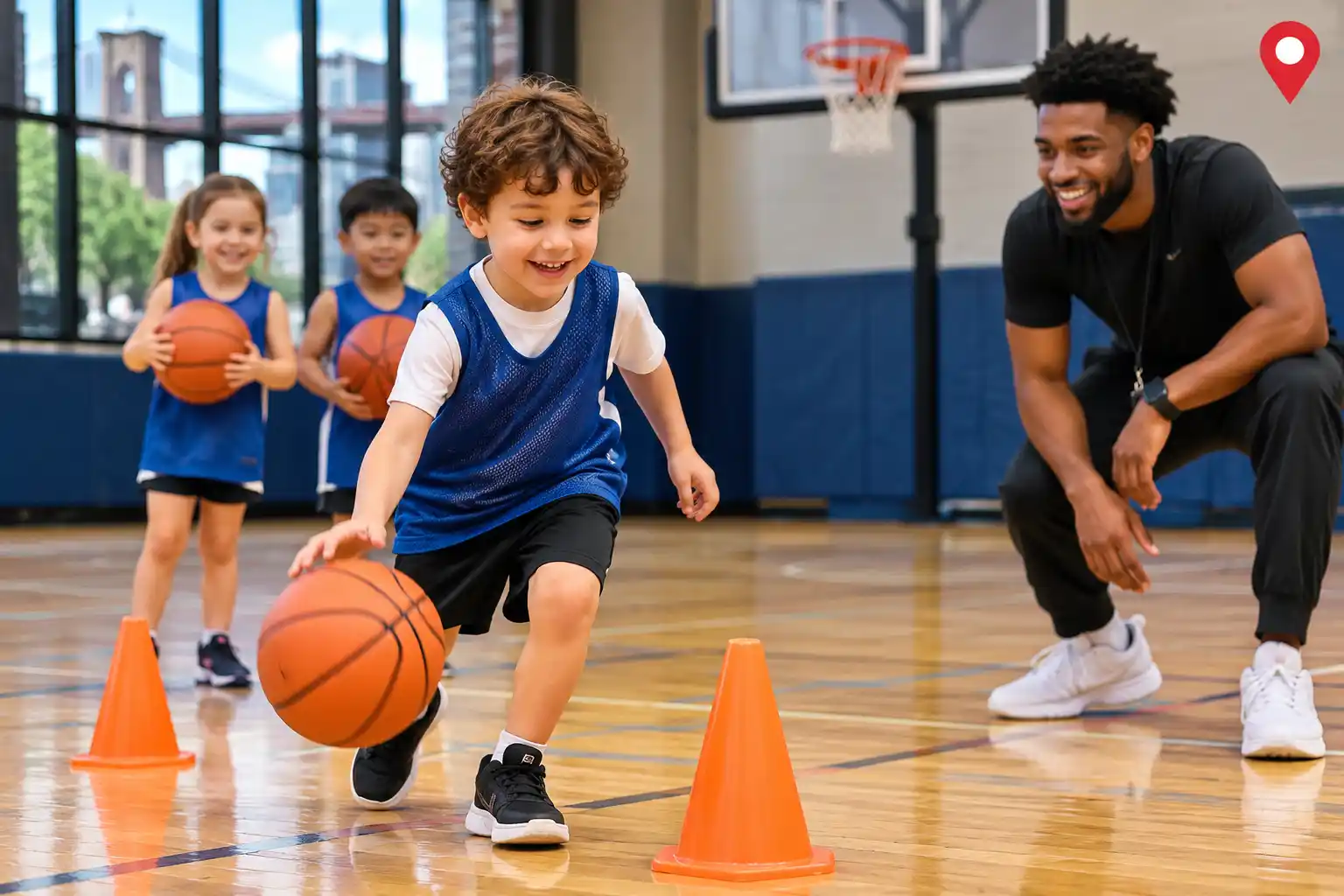
Suggested image placement: A child practicing beginner basketball drills with a small ball and low hoop, placed immediately below this heading.
1. Two-Hand Basketball Bounces
Skill: Ball control and hand coordination.
Start by asking your child to hold the basketball with both hands at waist height.
Have them push the ball toward the floor and try to catch it when it returns.
At first, one successful bounce and catch is enough.
As your child becomes more comfortable, encourage them to bounce twice before catching.
The goal is to understand how pushing the basketball downward changes its bounce.
Make it fun: Count the successful bounces together, without turning the activity into a test.
If the ball doesn’t bounce high enough, try a smaller, properly inflated ball on a firm surface.
2. Roll and Catch With a Partner
Skill: Hand-eye coordination and receiving the ball.
Sit or kneel a short distance from your child.
Roll the basketball gently across the floor and ask them to stop it with both hands.
When they’re ready, move slightly farther apart.
You can also create a small goal using two cones and ask your child to roll the basketball between them.
Make it fun: Pretend you’re passing supplies between two space stations. Each accurate roll completes a delivery.
This is particularly useful for children who aren’t comfortable catching a basketball in the air.
3. Red Light, Green Light Dribbling
Skill: Starting, stopping, listening, and beginner dribbling.
Use a familiar children’s game to introduce ball control.
When you say “green light,” your child tries to bounce the basketball.
When you say “red light,” they stop and hold the ball.
Don’t worry if your child needs to catch the basketball after every bounce.
For beginners, responding to the instruction and attempting the movement are meaningful parts of the activity.
Make it easier: Allow your child to walk while holding the ball, then stop and perform one bounce when you give a signal.
As control improves, introduce additional bounces.
4. Pass the Treasure
Skill: Gentle passing and catching.
Stand close to your child and hold a soft or lightweight basketball.
Demonstrate pushing the ball forward with both hands.
Ask your child to pass it back.
Initially, aim for a comfortable exchange rather than technically perfect chest passes.
If catching proves difficult, allow the ball to bounce once before your child collects it.
Make it fun: Imagine the basketball is a treasure that must be safely passed between teammates.
This activity also introduces cooperation and waiting for a partner to be ready.
5. Shoot at a Low Basket
Skill: Aiming, coordination, and introductory shooting.
Choose an adjustable hoop positioned at a comfortable height.
Let your child stand close enough to have a realistic opportunity to reach the basket.
Demonstrate a simple upward push using both hands.
For five-year-old beginners, there is no need to insist on adult shooting mechanics or a one-handed release.
Make it fun: Celebrate hitting the backboard or rim as well as making a basket.
If the hoop is still too difficult to reach, use a large container as a target and practice tossing a soft ball into it.
The objective is to experience aiming and releasing the ball successfully.
6. Basketball Obstacle Adventure
Skill: Balance, footwork, and movement coordination.
Create a short obstacle course using soft cones or other safe markers.
Ask your child to:
-
Walk around the first cone while carrying the ball.
-
Stop at the second cone and bounce the ball once.
-
Roll the basketball toward a target.
-
Collect the ball and return to the starting point.
Each part introduces a different movement.
Make it fun: Turn the course into a jungle adventure, rescue mission, or treasure hunt.
A simple story can help keep children engaged without needing to explain every technical basketball concept.
7. Pass, Run, and Celebrate
Skill: Cooperation, movement, and early teamwork.
This activity works with a parent, sibling, or small group.
Stand a short distance from your child and ask them to pass the ball.
After passing, they run toward a nearby marker, turn around, and prepare to receive the next pass.
For group activities, children can take turns passing the ball to different teammates.
Make it fun: Give everyone a team celebration after completing several successful passes.
The purpose isn’t to count how many mistakes occur. It’s to demonstrate that basketball involves sharing, communication, and playing together.
These seven activities create a useful introduction to basketball for 5 year olds because they focus on one manageable task at a time.
How to Teach a 5-Year-Old to Dribble a Basketball
One of the most common questions parents ask is:
Can my 5-year-old learn to dribble?
Yes, many five-year-olds can begin learning to dribble, although consistent one-handed dribbling may take time.
A child might manage several successful bounces one day and struggle with the same activity the next.
That doesn’t mean they’re failing. Dribbling combines hand control, timing, balance, and awareness of how the ball moves.
In an October 2026 discussion on Reddit’s basketball coaching community, coaches discussing four- and five-year-old beginners suggested starting with passing and two-handed bouncing before introducing one-handed dribbling. These are practical coaching suggestions, not scientific evidence, but they reflect a useful progression for beginners.
Step 1: Show, Don’t Just Explain
Young children often understand movements more easily when they can watch someone demonstrate them.
Stand beside your child and slowly bounce a basketball.
Explain that you’re pushing the ball toward the floor rather than hitting it.
Then let your child try.
Avoid giving several technical instructions at once.
Step 2: Begin With Two Hands
Ask your child to hold the ball and push it toward the floor using both hands.
Allow them to catch the ball after each bounce.
Once they’re comfortable, encourage them to use one hand for a single bounce.
The other hand can remain ready to catch the ball.
Step 3: Practice One Bounce at a Time
Instead of asking for ten consecutive dribbles, start with one controlled bounce.
After a successful attempt, try another.
As the child develops control, encourage two or three bounces before catching.
Progress should depend on comfort and coordination rather than a fixed deadline.
Step 4: Make the Ball Easier to Control
An adult basketball may be too large or heavy for a young beginner.
Try a smaller youth basketball that your child can comfortably hold and push downward.
A properly inflated basketball and suitable playing surface also matter. If the ball barely returns after being pushed down, check the equipment before assuming the child needs more practice.
Step 5: Add Movement Gradually
Once your child can bounce the ball while standing still, introduce walking.
Start with one bounce, catch the ball, and take a few steps.
Eventually, try bouncing while moving slowly.
Parent tip: Avoid comparing your child’s dribbling ability with another child’s. Some young players develop confidence with passing or shooting before they become comfortable dribbling.
A Simple Basketball Practice Routine for 5 Year Olds
A beginner basketball session doesn’t need to resemble organized team practice.
The following is an example of a playful 15-minute routine parents can adapt for home use. It isn’t a medical or developmental requirement, and children can stop or take breaks whenever necessary.
| Activity | Suggested Time | Main Focus |
|---|---|---|
| Running, walking, and stopping games | 3 minutes | Movement and balance |
| Two-hand bouncing | 3 minutes | Ball familiarity |
| Rolling and passing | 3 minutes | Coordination |
| Shooting at a low hoop | 3 minutes | Aiming and confidence |
| Favorite basketball game | 3 minutes | Enjoyment and choice |
What If My Child Loses Interest After Five Minutes?
That’s fine.
Rather than insisting they finish the routine, switch activities or end the session.
You might discover that your child enjoys passing but doesn’t like stationary dribbling yet.
Use that information to guide the next play session.
In a July 2026 Reddit discussion about coaching five- and six-year-olds, one youth coach described how beginners had very different abilities, even with basic passing. The discussion highlighted the importance of adapting activities when children struggle.
The practical lesson for parents is simple: choose drills that fit the child in front of you, not an idealized beginner.
How Often Should Five-Year-Olds Practice?
There’s no need to impose a demanding basketball training schedule.
Short, optional play sessions can be an accessible way to introduce the sport. Other activities such as running, jumping, playground games, and free play remain valuable.
The NBA and USA Basketball Youth Basketball Guidelines provide participation and rest recommendations beginning with the 7-to-8-year-old age group, but they do not prescribe a specific basketball practice schedule for five-year-olds.
For younger beginners, prioritize enjoyable participation, appropriate supervision, and rest over training volume.
Choosing the Right Basketball Equipment for Young Beginners
Basketball for 5 year olds becomes easier to introduce when children can handle the equipment comfortably.
Using adult-sized basketball equipment may make simple activities unnecessarily difficult.
Choosing a Beginner Basketball
Look for a lightweight youth basketball that your child can hold securely with both hands.
A smaller ball may help with rolling, catching, and bouncing.
Consider the playing environment as well. Some soft basketballs are suitable for gentle indoor games but may not bounce like a standard basketball.
For dribbling practice, choose a ball designed to bounce on the surface you’re using.
Selecting an Appropriate Hoop
A regulation-height basketball hoop isn’t necessary for an introductory basketball activity.
An adjustable hoop allows the basket to be lowered so younger children can experience shooting successfully.
The NBA and USA Basketball recommend modified equipment for young players, although their published competition specifications begin at ages seven and eight.
For a five-year-old, choose a stable hoop that suits the child’s reach and the available space.
Creating a Safe Playing Area
You don’t need a full basketball court.
A small open area can work for beginner basketball drills.
Before beginning, check that:
-
The surface is clear of toys, furniture, and tripping hazards.
-
The hoop is stable and properly secured.
-
The basketball is appropriate for the playing surface.
-
Your child is wearing comfortable clothing and suitable footwear.
-
Drinking water is available.
-
An adult can supervise the activity.
For indoor play, use activities and equipment suitable for the space. Avoid encouraging children to run or jump near hard furniture or other obstacles.
Suggested image placement: A small youth basketball beside a stable adjustable hoop, demonstrating age-appropriate beginner equipment.
Common Mistakes Parents Make When Teaching Basketball
Parents naturally want to help their children improve.
However, certain well-intentioned approaches can make basketball feel more frustrating than enjoyable.
Expecting Adult Basketball Skills Too Early
Teaching a five-year-old using the same instructions intended for an older player can create unnecessary confusion.
For example, explaining detailed shooting mechanics may be less useful than demonstrating how to throw a ball toward a basket.
Start with simple movements and introduce more technical instructions as the child becomes ready.
Correcting Every Mistake
Imagine your child tries to bounce a basketball but loses control.
You explain how to position their hand.
They try again and miss.
Then you correct their posture, hand placement, and stance.
After several attempts, they may begin focusing more on avoiding mistakes than enjoying the activity.
Try offering one simple instruction at a time.
Give children opportunities to experiment before correcting them.
Focusing Only on Making Baskets
Shooting is exciting, but it’s only one part of basketball.
Passing, movement, catching, and ball handling all provide valuable learning opportunities.
A child who hasn’t learned to shoot into a hoop can still enjoy basketball and develop useful foundational skills.
Making Every Activity Competitive
Competition can be enjoyable for some children, but it shouldn’t dominate every beginner session.
If a child becomes discouraged by losing, replace scoring games with cooperative challenges.
Instead of asking, “Who made more baskets?” try asking, “Can we pass the ball back and forth together?”
This changes the focus from winning to participating.
Practicing Beyond the Child’s Interest
A child who becomes tired or frustrated may need a break.
Continuing to insist on another drill doesn’t necessarily lead to better learning.
Parents should pay attention to enjoyment, fatigue, and comfort.
For additional information about how beginner coaching can progress into more structured skill development, explore Hoops Academy’s basketball curriculum.
How Basketball Can Help Build Confidence at Age Five
Confidence doesn’t always come from performing a skill perfectly.
For young children, it can develop through trying new activities, experiencing manageable challenges, and receiving encouragement.
Basketball gives parents several opportunities to create these experiences.
Celebrating Small Achievements
Imagine your child has struggled to catch a basketball.
During one session, they successfully stop a rolling ball and pass it back.
That moment may seem minor to an adult, but the child has completed something that previously felt difficult.
Acknowledging the specific effort can make the experience more meaningful.
Instead of saying, “You’re the best basketball player,” try:
“I noticed you watched the ball all the way into your hands.”
This directs attention toward the effort and action rather than a fixed judgment about ability.
Learning to Try Again
Not every pass will reach its target.
Not every shot will go into the basket.
Through supportive basketball games, children can experience missing a goal and trying another approach.
For example, if a shot falls short, you might invite your child to stand a little closer.
The child learns that changing an approach can make a difficult activity more manageable.
Developing Social Skills Through Team Activities
Basketball also creates opportunities for children to interact with others.
Simple group games can introduce taking turns, sharing equipment, listening, and encouraging teammates.
These experiences are particularly relevant when children join beginner basketball classes.
However, parents shouldn’t assume that participation automatically produces confidence or social improvement. Children’s responses vary, and a supportive environment matters.
Suggested image placement: Young children sharing a basketball during a supervised beginner group activity, illustrating participation and teamwork.
When Should Your Child Join Basketball Classes?
Home activities can provide an enjoyable introduction to basketball.
Structured classes may become useful when a child wants to play with other children or would benefit from guided activities.
A five-year-old doesn’t need to master dribbling or shooting before joining an appropriate beginner program.
In fact, introductory classes are intended to help children become familiar with the sport.
Signs Your Child Might Enjoy a Beginner Class
Consider exploring basketball classes if your child:
-
Frequently asks to play basketball.
-
Enjoys throwing, catching, or bouncing balls.
-
Shows interest in participating with other children.
-
Responds positively to simple group activities.
-
Wants to explore basketball beyond home play.
These aren’t strict enrollment requirements. A child with little previous interest may also enjoy an introductory session.
What Should Parents Look for in a Basketball Program?
Not every youth basketball program is designed for five-year-olds.
Before enrolling, ask whether the activities are specifically appropriate for preschool or kindergarten-age beginners.
Useful questions include:
-
What age groups participate in the same class?
-
Does the program accept complete beginners?
-
How much time is spent playing games versus following instructions?
-
Is the equipment suitable for younger children?
-
How do instructors support children who struggle with an activity?
-
How are safety, supervision, and parent participation handled?
The right learning environment should allow children to progress without being pressured to match older or more experienced players.
Beginner Basketball Classes in Brooklyn
For Brooklyn families exploring basketball for 5 year olds, New York Hoops Academy offers introductory programs for young children.
Its Pre-K basketball classes introduce foundational movements through playful drills, ball handling, shooting activities, and group participation.
The academy also describes Pre-K programming for ages four to six on its Greenpoint Brooklyn program page.
Families can explore other youth basketball programs and services to understand the different learning options.
For children who are ready for a more structured basketball experience, the academy offers youth basketball classes and developmental programs. Parents should confirm age eligibility because some of these programs are intended for older children.
Program schedules, enrollment details, and availability can change, so it’s worth contacting the academy before choosing a class.
Helping Your Child Enjoy Basketball Outside of Practice
A child’s interest in basketball doesn’t have to depend on formal lessons.
Small, enjoyable activities during everyday family time can introduce basketball concepts without making them feel like homework.
Let Your Child Choose the Game
Give your child two simple options.
“Would you like to shoot at the basket or play the passing game?”
This gives them some control over the activity.
A child who chooses the game may be more willing to participate.
Play Along Instead of Only Giving Instructions
Children can enjoy basketball more when parents participate.
You don’t need advanced basketball skills.
Roll the ball together, exchange gentle passes, or take turns shooting at a low hoop.
By participating, you’re demonstrating that basketball is an activity people can enjoy together.
Change the Activity When Necessary
Some days, a child may want to practice bouncing the ball.
On other days, they might prefer running around the court or tossing the basketball toward a target.
That flexibility is useful.
A beginner’s experience doesn’t need to follow exactly the same routine every session.
Introduce Simple Basketball Language
You can gradually introduce basic terms while playing.
For example:
Dribble: Bouncing the basketball against the floor while controlling it.
Pass: Sending the ball to another player.
Shoot: Trying to put the basketball into the hoop.
Teammate: Someone playing on the same team.
Using these terms during activities makes them easier to understand than presenting a list of definitions.
For more information about what children may experience in organized training, see our beginner’s guide to basketball training camps. Keep in mind that camp formats and age requirements differ from preschool beginner classes.
Frequently Asked Questions About Basketball for 5 Year Olds
Can a 5-year-old learn to dribble?
Yes. Five-year-olds can begin learning basic dribbling through two-handed bouncing, single bounces, and simple ball-control games.
Some children learn consecutive one-handed dribbles relatively quickly, while others need more time.
Start with manageable activities rather than expecting continuous dribbling immediately.
What size basketball should a 5-year-old use?
A small, lightweight youth basketball is generally easier for a young child to handle than an adult-sized ball.
Choose a ball your child can comfortably hold, pass, and bounce.
For dribbling, make sure the ball is designed for the playing surface and properly inflated.
How do I teach basketball to a child who can’t catch?
Start with rolling activities.
Sit close to your child and slowly roll the basketball toward their hands.
Once they’re comfortable stopping a rolling ball, try gentle passes that bounce once before reaching them.
You can gradually introduce catching a soft ball directly when they feel ready.
Should five-year-olds play full basketball games?
Full basketball games are not necessary for children just beginning to learn the sport.
Simple games involving passing, movement, shooting, and taking turns may be more suitable.
As children gain experience, they can gradually explore more organized forms of basketball.
How long should basketball practice last for a 5-year-old?
There’s no single ideal duration for every child.
A short play session may be enough for a beginner, especially if they’re new to handling a basketball.
A parent might begin with a few minutes and extend the activity if their child remains interested and comfortable.
The suggested 15-minute routine in this guide is an adaptable example, not a required training schedule.
What if my child doesn’t enjoy dribbling?
Try another basketball activity.
Some children enjoy passing, shooting, or movement games more than stationary ball handling.
There is no need to make dribbling the center of every session.
You can reintroduce it gradually through games when the child shows interest.
Do five-year-olds need private basketball coaching?
Not necessarily.
Many young beginners can start through informal family play or an age-appropriate group program.
Private instruction may be an option for families seeking individual guidance, but it’s not required for children to begin enjoying basketball.
For most first-time players, the immediate priorities are comfort, participation, and positive experiences.
Where can I find basketball classes for 5 year olds in Brooklyn?
New York Hoops Academy provides introductory basketball programs for younger children, including Pre-K programming.
Parents can explore academy locations and review the beginner basketball class options.
Contact the academy to confirm which programs currently accept five-year-olds.
Making Basketball a Positive First Experience
Basketball for 5 year olds works best when children have opportunities to explore, experiment, and enjoy learning.
A first basketball experience doesn’t need to include perfect dribbling, successful shots, or competitive games.
Rolling a basketball toward a parent, catching a gentle pass, or completing one controlled bounce can be a worthwhile beginning.
As your child becomes more comfortable, introduce additional activities and encourage them to choose what they enjoy.
If your child is interested in learning alongside other young beginners, an age-appropriate basketball class can provide another opportunity to practice simple skills and participate with other children.
Explore Youth Basketball Classes at New York Hoops Academy
Help your child discover basketball through beginner-friendly games, foundational movement, and guided activities.
Explore our youth basketball classes and Brooklyn locations, or contact New York Hoops Academy to ask about current Pre-K programs for five-year-olds.
Give your child a fun introduction to basketball, one small skill at a time.